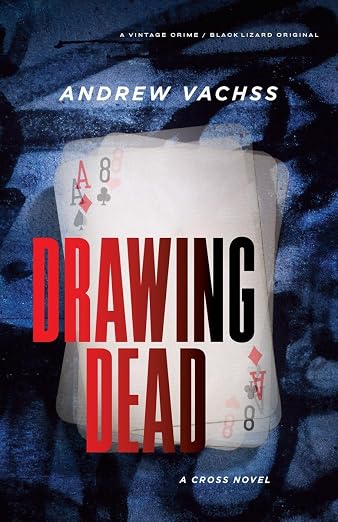
As Cross catches the scent of a far-reaching conspiracy, he realizes that it all connects to an unexplained event in his past: a massacre from which he emerged inexplicably unscathed, save for the blue mark on his face that pulses when danger is near. That scar has been throbbing more frequently of late. . . . If he’s reading the signs accurately, Cross might find himself again facing a terrible menace that is not altogether human.
It seems each of the last few columns has covered at least one pretty dark book. We looked at Richard Kadrey’s Sandman Slim last time out. Before that it was a couple of books by R. S. Belcher. Today it’s the latest in Andrew Vachss’s Cross series.
Vachss is best known for his dark crime/mystery novels, the most popular of which are in the Burke series. But while there’s an element of traditional (and certainly Vachss’s unique take on) hardboiled mystery in Drawing Dead, and it’s published by Vintage Crime, a house well-known for its mystery books, I’d consider it more of a supernatural/sf thriller with a touch of Cthulhu on steroids.
The Burke and Cross series have some similarities. Both are written in a tough, hardboiled voice, and center around families of choice living off the grid. Burke and Cross grew up raised by the state, spending much of the early parts of their lives incarcerated. But where Burke’s crew focuses its attention on predatory pedophiles, Cross’s crew are pure mercenaries.
Cross’s crew operates in Chicago. They’re the most feared of the city’s criminal organizations, so it makes no sense when someone attempts a hit on one of them. Who’d be that foolish? The answer has its roots in earlier books in the series, but new readers shouldn’t be worried, since we’re kept up to date through flashbacks and the like.
I’m not going to get into the supernatural elements of the novel – it’s complicated, and we don’t have the room here – but it’s a fascinating take and permeates every part of the story.
What draws me to Vachss’s work– beyond the fact that his books are addictively readable – is the loyalty of the characters to one another. In a time where friendships are so often only on social media and easily discarded, it’s refreshing to be reminded of the depth that these sorts of relationships can actually have.