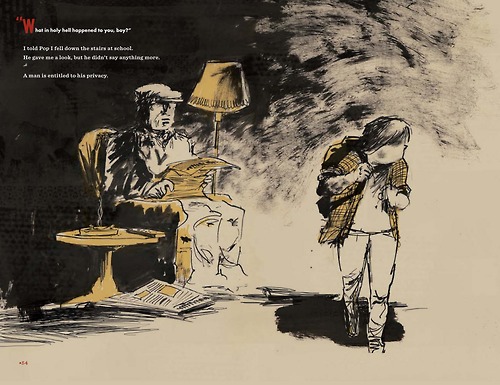
‘Kid, what on earth happened to you?’ I told Dad I fell down the stairs at school. He looked at me, but he didn’t say anything else. A man has the right to keep his privacy.
“Aberrance functions only within support groups. If aberrance is marginalized, it can’t metastasize.”
“So, school bullying: if the bully were ostracized, if the bully was the lowest-status person, if the bully was someone no one wanted to associate with, bullying could not spread. When the culture actually supports bullying, when the culture considers bullying a sign of masculinity—then it spreads.”
“The same thing with an institutional [prison] community: what’s tolerated; what’s not tolerated; what’s supported; what is a sign of actual manhood? So, for the first time, they [the inmates of the juvenile institution ANDROS II] were introduced to the concept that the most ‘man’ you can be is when you protect somebody weaker than you, and the least ‘man’ you can be is when you prey on them. Those were new messages, but they weren’t delivered in lectures; they were delivered by total bombardment, so the entire community reflected the culture.”
“Essentially, you’re trying to overcome a culture by replacing it with a different one. In order to change the culture, you have to start in the culture. You can’t start from the outside. So, saying ‘we disapprove of bullying’—everybody always ‘disapproves’ of bullying. But as long as the bullies are embraced within the school culture, they’ll continue.”
“If you look at bullying logically, then you can see it’s the root of all evil. Not money, but bullying. That’s all it takes: the imposition of your will, your desires, your wishes, on another human being by force or intimidation. You can see it in Rwanda just as easily as you can see it in the schoolyard. Different canvas, different color paint, but it’s exactly the same thing: ‘I can make you do what I want you to do, because I’m stronger than you. It’s not a question that I’m smarter or I’m more ethical or I’m more entitled. I’m simply stronger.'”
— Excerpted from An Interview with Andrew Vachss, by Jake Adelstein, Yomiuri Tokyo Bureau, 2002
“Verirrungen funktionieren nur innerhalb von Unterstützergruppen. Wenn Verirrungen marginalisiert werden, können sie nicht metastasieren.”
“So auch Bullying [Mobbing] in der Schule: wenn der Bully geächtet würde, wenn der Bully die Person mit dem niedrigsten Status wäre, wenn der Bully jemand wäre, mit dem niemand etwas zu tun haben will, könnte sich das Bullying nicht ausbreiten. Wenn die Kultur das Bullying sogar unterstützt, wenn die Kultur Bullying als ein Zeichen der Männlichkeit ansieht — dann breitet es sich aus.”
“Mit einer Gefängnis-Gemeinschaft ist es das gleiche: was wird toleriert, was wird nicht toleriert; was wird unterstützt; was ist ein Zeichen von Männlichkeit? Daher wurde [den Insassen des Jugendgefängnisses ANDROS II] zum ersten Mal das Konzept vorgestellt, dass man am meisten ein ‘Mann’ sein kann, wenn man jemanden beschützt, der schwächer ist als man selbst, und dass man am wenigsten ein ‘Mann’ sein kann, wenn man auf so jemanden Jagd macht. Das waren neue Botschaften, aber sie wurden nicht in Form von Vorträgen verkündet; sie wurden in einer totalen Bombardierung bekannt gemacht, damit die gesamte Gemeinschaft die Kultur überdachte.”
“Grundsätzlich versuchen wir eine Kultur zu überwinden, indem wir sie durch eine andere ersetzen. Um die Kultur zu verändern, muss man in der Kultur anfangen. Man kann nicht von außen beginnen. Wenn man daher sagt, ‘wir missbilligen Bullying’ — jeder ‘missbilligt’ Bullying immer. Aber solange die Bullies innerhalb der Schul-Kultur ein Zuhause finden, werden sie weitermachen.”
“Wenn man Bullying logisch betrachtet, dann kann man sehen, dass es die Wurzel allen Übels ist. Nicht das Geld, sondern das Bullying. Das ist alles, was es dazu braucht: eines Willen, eines Verlangen, eines Wünsche einem anderen Menschen mit Gewalt oder durch Einschüchterung aufzuzwingen. Man kann es in Ruanda ebenso leicht sehen wie man es auf einem Schulhof sehen kann. Andere Leinwand, andere Farbe, aber es ist genau dieselbe Sache: ‘Ich kann dich dazu bringen, zu tun, wovon ich will, dass du es tust, weil ich stärker bin als du. Es ist nicht die Frage, ob ich klüger oder ob ich moralischer oder ob ich mehr berechtigt bin. Ich bin einfach stärker.'”
— Auszug aus Ein Interview mit Andrew Vachss, von Jake Adelstein, Yomiuri, Büro Tokyo, 2002
“La aberración sólo funciona dentro de grupos de apoyo. Si la aberración es marginalizada, no puede hacer metástasis”
“Entonces, el matonaje* escolar: si el matón fuera objeto de ostracismo, si el matón fuera la persona de estatus más bajo, si el matón fuera alguien con el que nadie quisiera asociarse, el matonaje no podría propagarse. Cuando la cultura en los hechos apoya el matonaje, cuando la cultura considera el matonaje un signo de virilidad — entonces se propaga.”
“Lo mismo dentro de una comunidad institucional [carcelaria]: ¿qué es tolerado; qué no es tolerado; qué es apoyado; qué es un signo de hombría real? Así, por primera vez, a ellos [los internos de la institución juvenil ANDROS II] se les presentó el concepto de que lo más ‘hombre’ que pues ser es cuando proteges a alguien más débil que tu, y que lo menos ‘hombre’ que puedes ser es cuando te aprovechas de ellos. Esos eran mensajes nuevos, pero no fueron comunicados en charlas; fueron comunicados mediante un bombardeo total, tal que la comunidad entera reflejaba la cultura.”
“Esencialmente, uno está intentando derrotar una cultura por vía de reemplazarla con otra diferente. Para cambiar la cultura, uno tiene que empezar en la cultura. No puede empezar desde el exterior. Entonces, decir ‘estamos en contra del matonaje’ — todo el mundo siempre ‘está en contra’ del matonaje. Pero mientras los matones sean aceptados dentro de la cultura escolar, ellos continuarán.”
“Si uno mira el matonaje lógicamente, puede ver que éste es la raíz de todos los males. No el dinero, sino el matonaje. Eso es todo lo que se requiere: la imposición de la propia voluntad, los deseos propios, los propósitos propios, a otro ser humano mediante la fuerza o la intimidación. Lo puedes ver en Rwanda tan fácilmente como lo ves en el patio de la escuela. Diferente lienzo, diferente color de pintura, pero es exactamente lo mismo: ‘Puedo hacerte hacer lo que yo quiero que hagas, porque soy más fuerte que tú. No se trata de que sea más inteligente, o más ético, o tenga más derecho. Simplemente soy más fuerte.”
— Extraído de Una Entrevista con Andrew Vachss, de Jake Adelstein. Yomiuri Tokyo Bureau, 2002