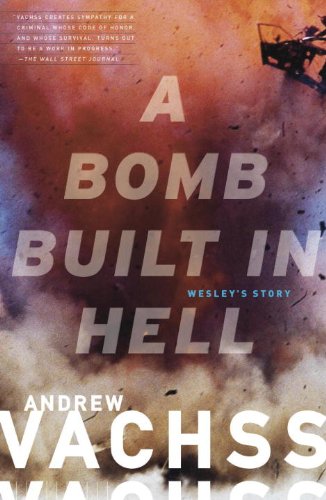
Before Burke, before Cross, Andrew Vachss created Wesley: a ruthless assassin who would stop at nothing to take out his targets. A Bomb Built in Hell is Wesley’s story.
While doing extended time for killing a fellow prisoner, Wesley meets Carmine Trentoni in a New York state prison. Carmine’s life sentence hasn’t cut him off from his outside sources, and he sees great potential in Wesley to carry out his revenge, and carry on his lucrative business. Wesley emerges from prison prepared to be the perfect hitman: calculating, deadly, and driven by money. On his release from prison, Wesley follows Carmine’s directions to locate a Mr. Petraglia—the Q to his working-class James Bond. Pet and Wesley set up shop in Brooklyn, and execute their assignments, from a rising Chinatown mobster to a visiting Haitian dignitary, with finesse—and, occasionally, more explosives than are strictly called for. But Wesley isn’t satisfied with his low-profile lot, and sets out to make a mark on the city that everyone will notice—which he does, in a shocking, dynamite conclusion.
“Andrew Vachss wrote his first novel based on professional experiences dealing with the children of abuse. He couldn’t find a publisher because they all felt it was too unrealistic, despite the fact that it was all deeply rooted in the real world; a world he had seen firsthand. But at the time, the collective mindset was that such things just didn’t happen. History has proven them wrong, and the book finally found a publisher.”
—Dagan Books
“[Phil] Gigante uses his voice to paint Vachss’ dark portrait with such vivid detail that it makes the novel even that much more shocking. Like a musician finally finding just the right song, Vachss’ world is the perfect fit for Gigante, and together they create something special.”
—The Guilded Earlobe
“History has caught up to Wesley’s bleak odyssey, repeatedly rejected for publication decades ago but now unnervingly prescient.”
—Kirkus
Wesley, who appeared in a number of Vachss’ legendarily dark Burke novels, is the protagonist of this hard-bitten tale written in 1972, more than a decade before the first Burke novel appeared. It’s the story of an orphan who, by the mid-1950s, had spent much of his life in New York’s juvenile-detention system before graduating to maximum security. There he meets Carmine, a tough old murderer who educates him to be a better criminal. Wesley comes to see himself as Carmine’s son and ultimately as the instrument of Carmine’s vengeance. Wesley does his time and, as per Carmine’s instructions, becomes a professional hit man. A Bomb Built in Hell presages motifs Vachss employed in the Burke novels, but even crime fans unfamiliar with Burke can relish it. Wesley is utterly remorseless, and the story is told in the coldest and sparest of prose. It also features telling period details—e.g., the tawdry and seamy Times Square area of the time, and the homeless who rushed to “clean” the windshields of cars stopped at Bowery traffic lights.
—Thomas Gaughan
Vachss’ prose, though not as stylized as the writing that would take the mystery world by storm in Flood, is as tight and succinct as Wesley’s meticulously planned murders. Every Burke fan should read this novel.
—Publishers Weekly, Sept 18, 2000
In 1972, I was represented by the John Schaffner Agency, largely on the strength of some short stories I published in minor magazines.* My first full-length effort was, essentially, the journal I kept during my time in the infamous NYC Welfare Department between 1966 and 1969, ending when I left to enter the warzone inside a country calling itself Biafra.** That book was (as was all my work prior to Flood) considered unacceptable by the publishing establishment, on the grounds that there was no market for “this kind of material.”
Victor Chapin, my tireless agent, who never lost faith in me, thought my varied ground–zero experiences (including, by that time, not only the genocidal madness in Africa, but a stint as a federal investigator in sexually transmitted diseases, working as an organizer in Lake County, Indiana, running a center for urban migrants in Chicago, a re–entry joint for ex–cons, and a maximum–security prison for violent youth) would lend themselves perfectly to a “hardboiled” novel of the type that was so successful in the ’50s. A Bomb Built in Hell followed.
And (again) was unanimously rejected by publishers. They professed to love the writing, but felt the events depicted were considered a “political horror story” and not remotely realistic. The rejection letters make interesting reading today. Included in the “lack of realism” category were such things as Chinese youth gangs and the fall of Haiti. And, of course, the very idea of someone entering a high school with the intent of destroying every living person inside was just too … ludicrous.
Naturally, the book was also “too” hardboiled, “too” extreme, “too” spare and violent. I heard endlessly about how an anti–hero was acceptable, but Wesley was just “too” much.
Bomb was meant to be a Ph.D. thesis in criminology without the footnotes, exploring such areas as the connection between child abuse and crime, and the desperate need of unbonded, dangerous children to form “families of choice.” Thus, the narrative is third person, and the tone is flat and detached.
Victor, ever–loyal, insisted that there was no dispute about my ability as a writer, but that I needed to add some intimacy to a book everyone called “dry ice.” So … Flood. Same themes, but first–person narrative, interior monologues, fleshed–out backstory, (some) characters with which the reader could identify (and even, presumably, like). Some sense of human connection. But the same themes.
Victor read the manuscript and told me I had finally done it … we were winners. And then he died. Suddenly and unfairly.
Years later, after Flood came out, offers for Bomb magically appeared. Some from the same publishers who had rejected it the first time. I never took the offers, thinking of the original book as a “period piece.” Later, at the suggestion of Knopf publisher (and my editor) Sonny Mehta, I cannibalized pieces of it—Bomb was Wesley’s story, Flood was Burke’s—for Hard Candy, and Wesley remained a character in the series (despite being dead since Candy) until its 2008 conclusion, Another Life.
Rumors of the original book’s existence were sparked by an excerpt published in the HBJ series A Matter of Crime in 1988, edited by Richard Layman.
The rumors were true. And how I wish some of the book’s predictions had not proven to be so.
I dedicated Flood to Victor Chapin. And I dedicate this to him as well. It’s been a long wait, old friend. I hope it reads as well from where you are now.
Andrew Vachss
New York