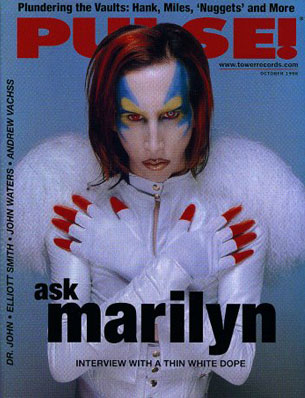
In the decade since Suzanne Vega’s “Luka,” artists from 10,000 Maniacs to Aerosmith have written songs about child abuse. But questions remain: To what extent can popular music truly be a vehicle for social change? And at what point does an artist cross the line between exploring and exploiting a social issue? We asked legal advocate/crime novelist/blues aficionado Andrew Vachss to consider these issues and write about the challenge of addressing social issues through popular media. A children’s rights lawyer who moonlights as author of the acclaimed Burke investigative novel series for Black Lizard, Vachss uses his fiction as a way of bringing to light issues too disturbing or controversial to be addressed in contemporary discourse. —Bill Forman
Pulse! asked me my opinion as to whether music can be a vehicle for social change. I gave it some thought, and here’s what I came up with: “Social change” isn’t necessarily a synonym for “progress.” Ask any skinhead wetbrain impatiently waiting for the Fourth Reich what music he listens to. Or how gay folks feel listening to gangsta rap. Sure, music is life. “Real” life. And life as we wish it to be. And life as liars claim it to be.
Child abuse is all of the above too. And music lyrics are replete with references to it, most folks dating the phenomenon from Suzanne Vega’s “Luka” to Korn’s latest angry outbursts (although the Who’s Tommy was decades earlier, and its “Fiddle About” was clearly chasing the same dragons).
But is music a “vehicle” for social change? More like a passenger, the way I see it. Assuming the goal extends beyond an individual artist’s desire to express his or her feelings on the subject (or a mercenary desire to capitalize on a faddish topic), the question becomes: Does addressing social issues with art actually change anything?
Well, “consciousness–raising” presumes there is a “consciousness” to raise. Viagra won’t cure castration. And, even if “consciousness” existed and could be “raised,” how would we measure such a phenomenon except through conduct? If people’s feelings change as a result of exposure to art, that’s nice.
But that’s all.
Here’s an example from ground zero. When it comes to “pedophilia,” I agree that to “feel the feelings” may be (as defense attorneys routinely claim) “sick.” But to act on those feelings is evil. And should be dealt with accordingly.
So no matter what music might make you feel, it’s what you do with those feelings that matters. The truth is this: The notion that music is going to motivate so–called humans to stop torturing their children is as ludicrous as Judas Priest driving teenagers to suicide, comic books turning children into juvenile delinquents, or nude pictures causing rape.
| Words may evoke feelings. They don’t, in and of themselves, cause conduct. |
See, way before the “keeping it real” nonsense caused performers to fabricate backgrounds of crime and violence for “credentials,” there was a stronger, deeper saying: “Blues are the truth.” Originally, blues music was evaluated by its ability to evoke “I’ve been there” feelings in the listeners. They knew it was true when they heard it. If your woman had left you for another man, and you heard the same story sung on stage, you might feel that pain all over again. But “Your Cheatin’ Heart” didn’t make anyone wake up the next morning and change partners.
So, words (whether spoken, sung, read) don’t so much motivate as reflect. What they may do is provide some handy tips as to method for a motivation that already exists.
That’s why the Emergency Rooms of big cities are full of sociopathic little triggerboys with unique facial damage from shell casings ejected into their eyes when they held their precious nines parallel to the ground, Hollywood style, instead of the way the pistols were designed. Movies didn’t give them the desire to commit homicide… but they sure showed them “how.”
Words also validate. If others feel what you feel, then you’re not alone. That’s a two–edged sword, people.
For example: That’s what kiddie porn does. It doesn’t simply memorialize evil, it allows the possessor to see that there are others of his ilk. That he’s not a “freak.” No, he’s a person with certain tastes, shared by others. An “alternative lifestyle,” if you will.
Sure.
But (anti) child abuse lyrics often have the same effect on victims that kiddie porn does on predators. They too are not alone. The Children of the Secret are a vast tribe. Brothers and sisters who share a common experience but have not yet bonded around it. And that potential exists as well.
| You can’t have it both ways. You can’t say ‘devil lyrics’ don’t drive kids to commit crimes and simultaneously claim that “Luka” made people stop beating children. |
I am not dismissing the power of music to make change. Music may not have charms to soothe the savage beast, but it can certainly wake it up.
Music can wake you up… but if you stop dancing as soon as it stops, what good has it been to anybody but you?
That isn’t what battling the monster of child abuse is all about.
As for “exploitation,” that one is almost too tired to respond to any more. Sure, writing about anything ugly can titillate some degenerates. There are human slime somewhere watching TV footage of Bosnia or Rwanda and getting all excited (in the clinical sense) about the prospect of expanding that “solution” to America. Does that make war correspondents “exploiters?” To level that charge against artists from a country where Jerry Springer rules his time slot and the National Enquirer outsells the Encyclopedia is… ah, it’s just stupid.
Truth is: Most consumers of platinum–selling gangsta rap are white. And the music industry defends the vilest, ugliest, most reprehensible “lyrics” on grounds of freedom of speech. Can you spell “hypocrisy”? If the real goal was to give everyone a forum, how come the racist analog to gangsta rap—”white power” music—can’t find a major distributor? The answer is simple enough: It doesn’t sell.
Can music make a difference in changing (as opposed to simply recording and reflecting) history? I don’t know. I do know it’s worth a shot. Child abuse has always been the safest crime in the world to commit, thanks to, among other things, a lack of awareness of its reality. But we’ve been “aware” for quite a while now. And the home is still the most dangerous place to be a kid.
| There’s a wall that has to come down. Anyone who swings a hammer at it deserves a medal in the only “Holy War” worthy of the name. No one should care who strikes the final blow, but we have to care enough to keep pounding. |
Truth is in the motive. You are what you do, not what you say. Anyone can claim their music is making a political statement. Anyone can believe it. But until a piece of music starts swinging hammers and elections, it hasn’t got a beat anyone trying to change this junkyard of a planet can dance to.
© 2000 Andrew Vachss. All rights reserved.
Andrew Vachss’ newest novel is Safe House (Black Lizard),
which has a companion blues CD, Andrew Vachss’ Safe House (Relativity).